
Stop Being So Upright
One of the most common and frustrating ways to miss lifts is chasing a too-upright position, specifically in snatches (overhead squats) and jerks (the dip and the split).
Today we’re going to figure out why being bolt-upright isn’t actually much use for you, the problems you’re causing that you could simply not, and how those shape up in the squat, snatch, and jerk respectively.
If you’re tired of missing all your lifts out front when you thought your pull was nice, this one is for you.
Why Is This Such A Common Issue For Olympic Weightlifters?
First, to quote David Byrne, how did I get here?
The torso position is something we always keep in mind in Weightlifting. In fact, I’ve even written about how the hips control the torso - which is probably going to be required reading to get the most from today’s article.
The short story is this: many beginner lifters try to be more upright because they watch elite lifters who have incredible mobility and stability, and they sit really upright in their squats and snatches, so if I get more upright I’ll be better at the sport!
The unfortunate fact is that this isn’t true, and it’s also confusing the symptom with the cause. Lu Xiaojun is very upright because he has exceptional mobility, and being upright isn’t the reason he lifts well - it’s just a visible outcome.
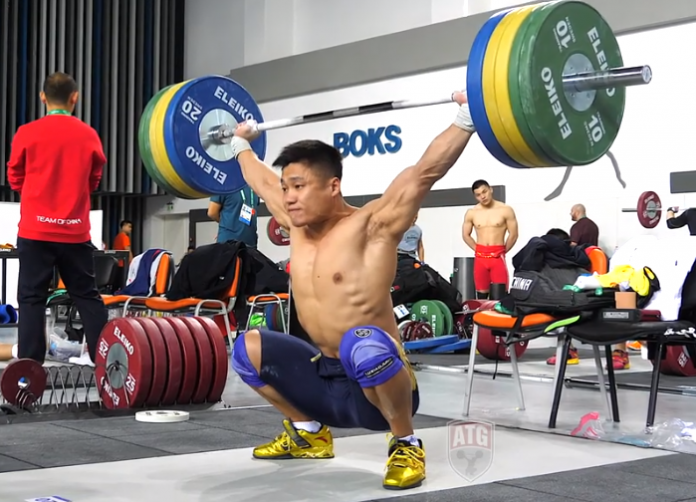
This is the correct level of upright for Lu - one of the world’s most flexible overhead squatters - so it’s probably not quite what you should be aiming for in torso angle…
So this obsession with imitating a select group of elite level lifters - and notably not others, like Marcin Dolega who leans forwards a lot - is selective focus. It’s foundational to step back from this assumption and take a look at the broader landscape, or just your level of training!
The Problems Caused By Being Too Upright in the snatch or clean
The main problem with this attitude to torso position is that it ruins a lot of other, very important things.
First, it means that you’re not squatting properly. As discussed in backwards hip pressure, you have to incline your torso and push your hips back to keep the muscles around the hips active and keep your balance.
As your knees move forwards, your hips have to move back.
So, when you try and stay upright despite not having the stance and mobility for it, you just move your weight out of position in the foot - either losing your heels or losing your toes, depending on your personal flavour of overcompensating.
Then, finally, you don’t have a secure position for the bar overhead, and what usually happens is that you dump all of the weight of the bar into the connective tissues of your shoulder without the muscular support that helps keep them in position to absorb force safely.
When you’re too upright in the snatch or jerk, you’re ignoring the fact that the bar has to move across the body from in front to behind. Inclining the torso in the receiving position means this is much easier and we’re committed to the bar-behind-the-head position that is so stable.
A deliberate amount of torso inclination can immediately save you from these woes, especially if you tend to find that you’re missing lifts out in front.
Learning to incline the torso
The squat is definitely the place to start because it’s simpler, it’s important based on what I discussed in backwards hip pressure and hips control the torso, and it can be trained without too much other complexity like pulling and turnover and so on.
When we squat with controlled torso inclination we keep the hips in the lift, balance through the foot pressure, and a proper mixture of leg and hip input. This leads to reliable, predictable squats.
This is the foundation for the Overhead squat because the position is the same, with the exception that we have to support the bar with the arms and shoulders…
Transferring To The overhead squat
When we practice this in the overhead squat, it has the added benefit of improving shoulder control.
And the added challenge of needing more shoulder control.
A bar that is above the head is in a poorly-controlled position and athletes who snatch to this position most commonly have shoulder issues or knee issues. This is because they either:
Absorb the poor balance in the shoulders, absorbing force in unsustainable ways, or
Have extreme lower body positions in the knees and/or hips.
These push the issues of an excessively upright torso onto other tissues, which ultimately leads to overuse injuries as training tonnage builds up and Olympic Lift variations approach the athlete’s total strength capacity.
Between the mixture of injury risk and missed lifts, it’s not hard to see why I’m obstinate about fixing this issue. It’s a technical model change that saves careers, much like the hip-back thing I discussed above (this is actually just the more complex version for the Snatch and Jerk).

For almost everyone, the deliberate inclination of the torso through the bar is an essential step to properly firing the musculature of the upper back and a secure catch (Image: Catalyst Athletics)
torso angle in the split jerk (and power jerk)
The Jerk is where most people really run into this issue and it is shocking that it’s not discussed more often.
We often see less-experienced athletes, and especially CrossFit or other feeder-sport athletes, struggle with finishing the jerk behind the bar. This is a hugely frustrating way to miss because you’ve already cleaned it and you’ve probably put good height on the bar.
Even worse, when you don’t know the issue it feels like you did everything else right!
But the jerk is like the Snatch in the sense that it asks you to move the bar across the body. Perhaps more correctly, it asks you to move into the bar so it crosses your body, with the bar and body moving in opposite directions to reach maximum efficiency.
When we don’t incline the torso in the jerk, we start to reach back with the rear leg, pull the hips back, look up at the bar, and completely fail to secure it behind the head. This is because the jerk has the least potential for moving the bar backwards - you’re already upright in the drive!
This means the jerk requires you to combine stepping in with torso inclination so you can rapidly fix the bar behind the head - in roughly the same position as your back squat or overhead squat, relative to your centre of gravity!
This is more clear in elite power jerkers, who have to kick the hips back and chest through very quickly, and it’s one of the main reasons we might use the power jerk + paused split jerk to reinforce the movement and position.
Ilya Ilin once again serves as a best-in-class reminder of the importance of using torso inclination as part of a crisp, perfect jerk:
Final Thoughts
The lineage of fixing this issue starts with just not doing it wrong, like so many others. The idea is to train it in this kind of general order, so that each exercise emphasises the change and you can feel the difference in increasingly complex movements:
The back squat
The overhead squat
The heaving Snatch balance
The Snatch balance
The hip Snatch
The hang Snatch or block Snatch
(Optionally) The paused Snatch
The Snatch - pretty crucial!
You can also get a lot of bang for your buck with no-foot power snatches for this, but they introduce a lot of tempo and other forms of complexity which might not be useful if you’re feeling a bit overwhelmed as it is.
For jerks, it’s very clear in elite power jerkers, who have to kick the hips back and chest through very quickly, and it’s one of the main reasons we might use these exercises to reinforce and emphasise the position:
Press in split
Split position power Jerks
Push Jerks (no-foot power Jerk)
Power Jerks
Paused Jerks (dip and split)